Near-infrared is rejected
Multilayer and ceramic films reflect or absorb the infrared band that carries most of the sun’s heat, so less energy crosses the glass in the first place.
Solar control
Solar film rejects the sun’s energy before it turns into cooling load — without swapping the glazing, blocking the view or emptying the room of daylight.
How it works
Sunlight arrives as ultraviolet, visible light and near-infrared energy. A good solar film is engineered to handle each band differently — which is why “dark film” and “cool film” are not the same thing.
Multilayer and ceramic films reflect or absorb the infrared band that carries most of the sun’s heat, so less energy crosses the glass in the first place.
Visible light is trimmed to a level that suits the room. A screen-readable office and a bright living room need different numbers.
More than 99% of UV is stopped at the film, the main cause of faded flooring, fabrics, artwork and retail stock.
Glare
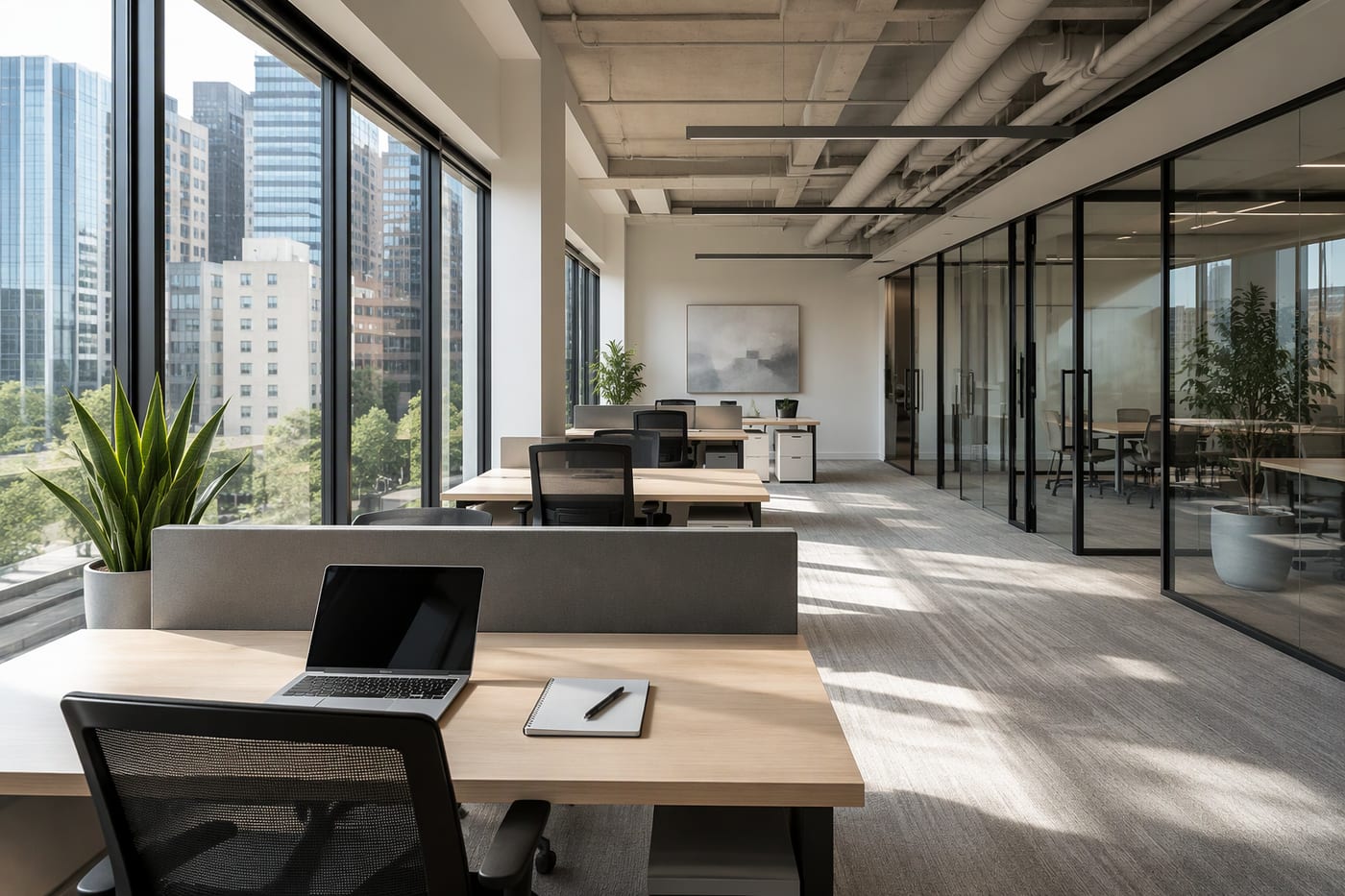
On a bright perimeter floor, the fix is usually blinds down — which trades glare for electric lighting and loses the view tenants pay for.
Film lowers the daylight that reaches the desk to a workable level while keeping the window transparent. Screens stay readable, blinds stay up, and the perimeter zone stops being the seat nobody wants.
Grades
We stock neutral, spectrally selective and ceramic constructions. The right one depends on orientation, glass type, occupancy and how much daylight you want to keep.
| Grade | VLT | TSER | Colour | Choose it when |
|---|---|---|---|---|
| Neutral solar (6 mil) | 30–40% | 50–60% | Charcoal / grey | Cooling load is the priority and the room is already bright |
| Spectrally selective | 50–60% | 42–52% | Slight blue-grey | You need heat rejection without a dark interior |
| Ceramic clear | 65–70% | 40–48% | Near-colourless | Retail, living rooms and heritage glazing where appearance matters |
| Dual-reflective | 35–45% | 55–65% | Reflective out, neutral in | High-exposure facades where night-time privacy is not a concern |
Ranges are typical published figures and vary by manufacturer and glass substrate. The quoted performance for your project comes from the manufacturer’s data sheet for the exact film and glass combination, and we can verify it against on-site meter readings.
Specification
Film is only as good as the glass it goes on. These checks happen at survey, before a price is issued.
Clear, tinted, reflective or low-e coated glass all behave differently. Some already perform well enough that film adds little.
Absorptive film on certain tinted or sealed-unit glass can raise edge temperatures. Where risk exists we change grade or decline the pane.
Units already showing seal failure or condensation are flagged — film does not fix a failing unit and can hide the symptom.
West and south-west elevations usually give the strongest return. North glass often needs nothing at all — we say so.
Where film is the wrong answer. If your glass is already high-performance low-e, if the room is dark and overheating comes from equipment rather than sun, or if the units are at the end of their life, replacement or mechanical shading may be the better spend. We will tell you at survey rather than sell you film.
Questions
It depends on the glass, orientation, climate and how the building is run, so we do not quote a percentage. What we can give you is the film’s published SHGC and TSER for your exact glass, plus before/after surface-temperature readings on a sample pane. Your engineer can then model the load reduction properly.
Only if you choose a dual-reflective grade. Neutral and ceramic films are the opposite — from outside they read as slightly darker glass. We show both in daylight before you commit.
Yes, after a 30-day cure. Use a soft cloth and a normal glass cleaner without abrasives or ammonia-heavy degreasers. We leave a care sheet and spare film for edge repairs.
With the lights on and darkness outside, interior visibility from the street increases on most films. If night-time privacy matters, we specify a different grade or combine film with blinds.
A free survey includes sample panels on two or three of your windows, so the decision is made in your light, not in a showroom.