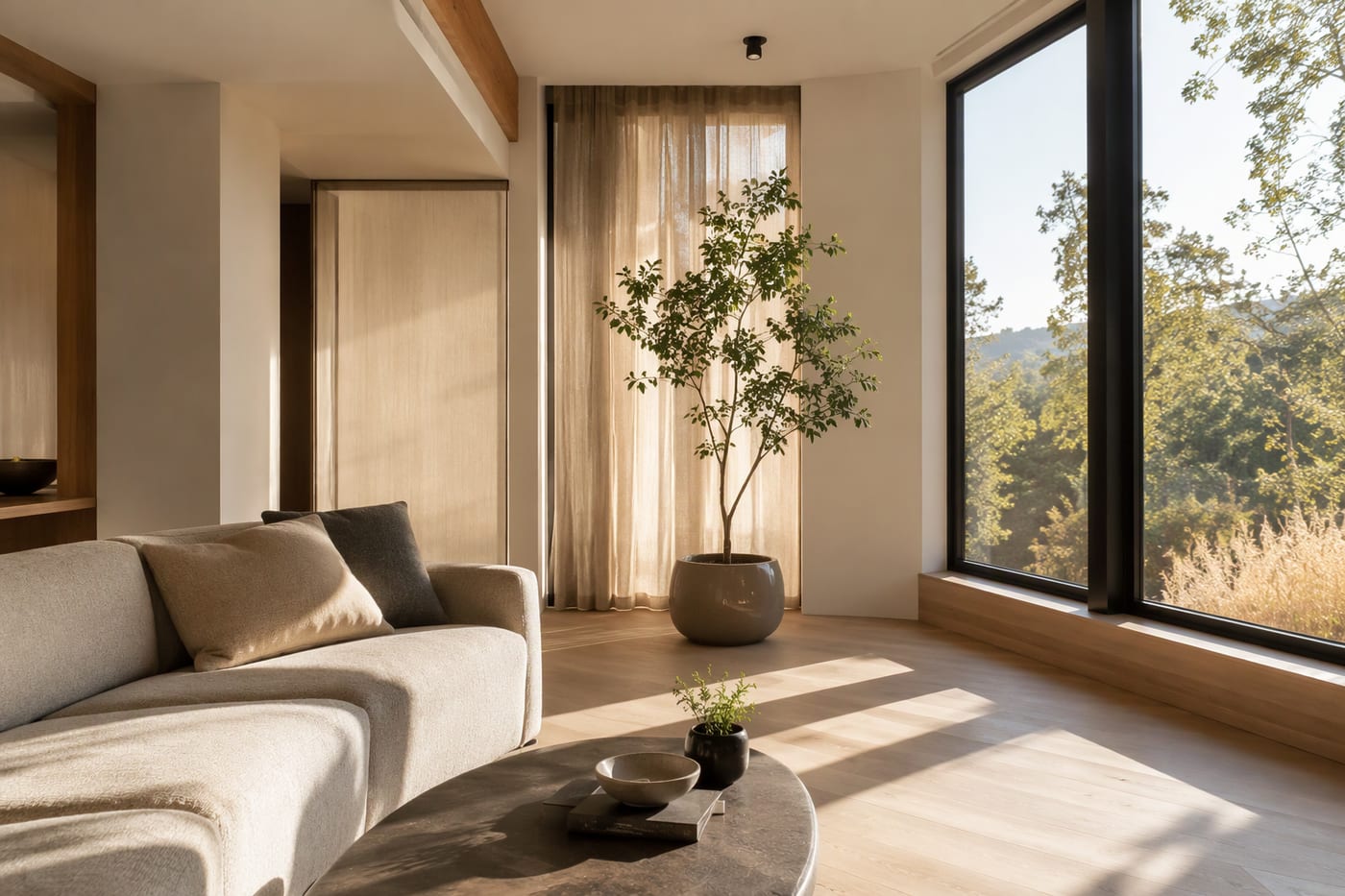
A buyer in Dubai, Kuala Lumpur or Darwin does not need persuading that solar gain is a problem. The interesting questions start after that: which construction survives the climate, how the film is installed at 45 °C, and what the site will look like in year four.
The climate is not one variable
Hot-humid and hot-dry markets fail film differently. In the Gulf, the load is dust, intense UV, high ambient temperature and frequent cleaning. In Southeast Asia, it is humidity, monsoon-driven water loading on facades, and condensation on cold interior surfaces. In northern Australia, it is UV plus cyclone-season wind pressure on the glazing.
The film choice follows the failure mode. Dust and cleaning abrasion argue for a hard-coated construction. Humidity argues for edge sealing and against exposed adhesive at the perimeter. Cyclonic wind load argues for the frame and fixing, not the film.
Installation temperature is a real constraint
Film does not apply well to glass that is hot from direct sun, and it does not apply well below the manufacturer's minimum temperature. In a Gulf summer both limits can be hit in the same day: a west elevation at 4pm is too hot, and an early morning start can be too cold relative to the slip solution's behaviour.
The practical answer is scheduling — interior work early, shaded elevations first, and exterior work only when the glass is out of direct sun. Crews that ignore this produce trapped moisture, bubbles and early edge lift, and the film gets blamed.
Condensation, the quiet killer
In air-conditioned buildings in humid climates, the interior face of single glazing runs below dew point for much of the year. Film applied to that surface is on the wet side of the glass. Water sits at the film edge, wicks under the adhesive, and the perimeter goes milky.
Where that condition exists, the specification has to include edge sealing and a realistic conversation about service life. It is also the case where a cheap film fails visibly within a year, and where the buyer concludes that all film is the same.
Salt and coastal sites
Metallised films on coastal buildings can corrode at the edge if moisture reaches the metal layer. The visible symptom is a dark or discoloured border. Ceramic and non-metallised constructions are less exposed to this, which is one of the few cases where the ceramic premium is straightforwardly justified.
What a distributor should stock
For a hot-climate market, a workable range is narrower than a European catalogue: one high-rejection metallised series for volume, one ceramic series for signal-sensitive and coastal work, and a safety film for the storefront and school segment. Deep privacy shades sell less than buyers expect, because the cooling load is already the conversation.
Pack for the climate too. Film stored in an uninsulated warehouse at 50 °C ages faster than the datasheet assumes, and the buyer discovers it at installation. Ask your supplier what the storage specification is, and hold stock accordingly.
The short version
- Hot-dry and hot-humid markets fail film for different reasons; specify for the failure mode.
- Schedule application around glass temperature, not around the crew's convenience.
- On air-conditioned single glazing in humidity, expect condensation at the edge and seal for it.
- On the coast, consider non-metallised constructions for the perimeter's sake.
- Storage conditions are part of the specification in a hot market.