Reflective
Reflective film: the cheapest heat rejection, and its one catch
A metallised layer turns the glass into a mirror. It is the most cost-effective way to cut solar gain per square metre — and the fastest way to upset a neighbour, a planning officer or a night-shift staff room.
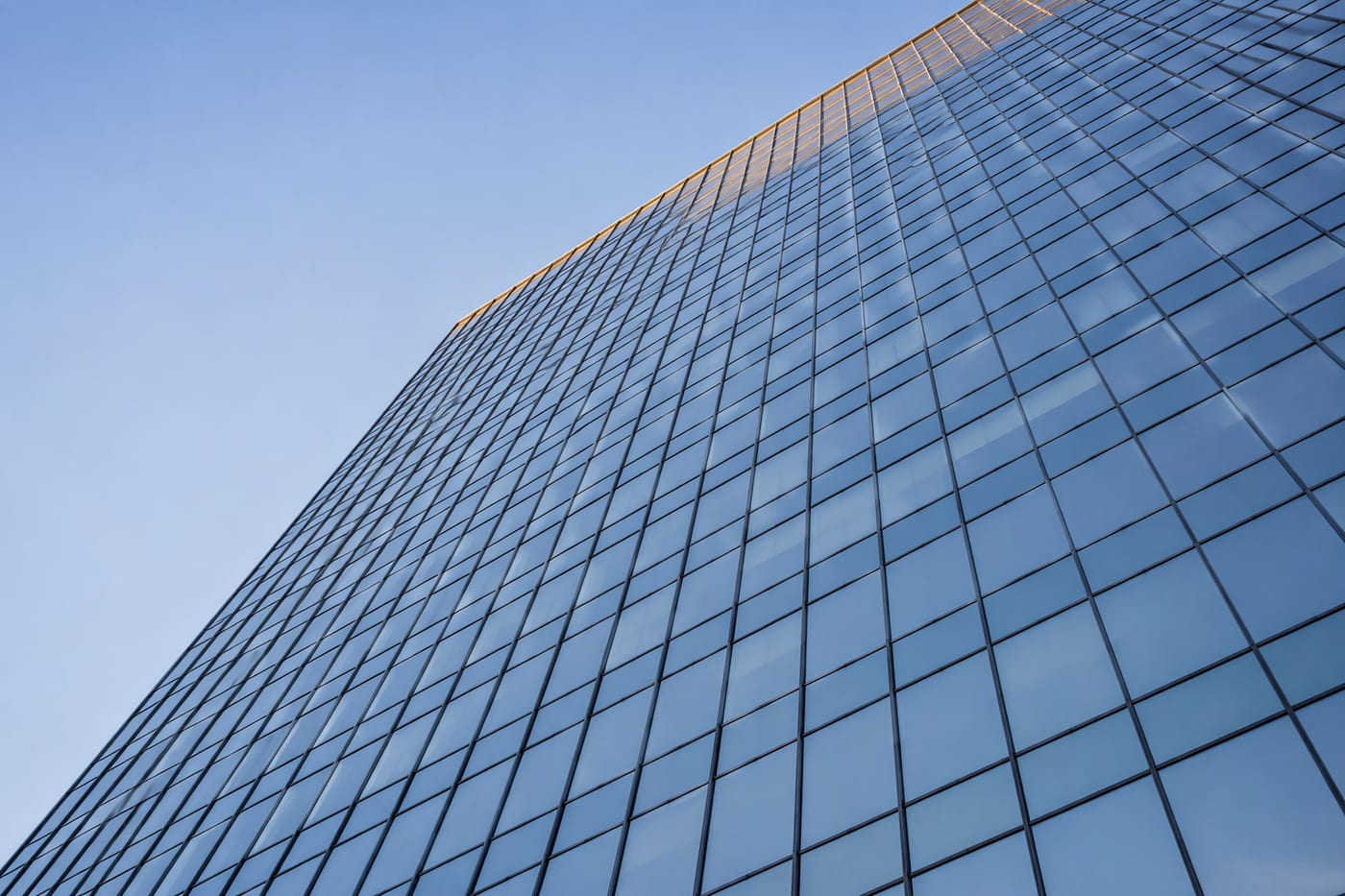
Detail
The one-way effect is a daylight effect
While the outside is brighter than the inside, the glass reads as a mirror and the occupants keep their view. After dark, with the lights on, the relationship reverses: the street can see in.
This is physics, not a manufacturing defect, and it belongs in the quotation in writing. We will not sell reflective film as a privacy or security measure.
Applications
Where it earns its place
West and south elevations on office blocks, warehouses with glazed offices, retail units that want to hide stock from the street in daylight, and residential glass where the neighbouring facade is far enough away that the reflection is not a nuisance.
Where the client needs a neutral appearance, ceramic or clear film is the better specification even at a higher price.
- Silver, grey, blue, green and bronze faces
- Interior application, standard roll widths
- Can be combined with a safety laminate
Design
The day–night reversal, and how to plan for it
Every reflective film relies on the outside being brighter than the inside. At night the ratio flips and the glass becomes transparent from the street. This is not a defect and no grade avoids it — it is how a partially mirrored surface behaves.
The planning answer is to separate the two uses. Where the interior is lit after dark and privacy matters, pair the film with blinds, a frit or a gradient band. Where the room is unlit at night, the film keeps working and nothing needs adding.
Retail is the awkward case: shopfronts are lit until late, and the film that hides stock in daylight shows the shop floor at 9pm. Tell the client before the order. A shop that discovers this on opening night will not reorder, and no amount of correct specification language fixes the relationship.
Technical
Reflective film on coated and laminated glass
Reflective films absorb and reflect, and both raise the temperature of the glass they are bonded to. On clear annealed float that is usually tolerable. On tinted glass, on laminated glass and on sealed units, the margin is smaller and the failure mode is a cracked pane or a failed edge seal.
The check is straightforward and should happen before the order: glass type, thickness, pane size, frame constraint, and orientation. Where the combination is marginal, the options are a lighter grade, an exterior film, or no film on that elevation. All three are better answers than a warranty claim.
On low-E sealed units, an interior reflective film is usually the wrong choice — the coating is already doing the reflective work, and the film adds absorption to a unit that was not designed for it. An exterior grade, or a ceramic interior film at a lighter shade, is the safer route.
Questions
Before you ask
The three questions that come up on almost every enquiry.
Will reflective film affect my neighbours?
It can — a mirror facade throws light and heat onto whatever faces it. On tight urban sites, check before ordering; on some elevations the answer is a neutral film instead.
Does it stop people seeing in at night?
No. At night the effect reverses. If privacy is the requirement, use a frosted or gradient film and accept the loss of view.
Can it be applied over existing tint?
Generally no — two layers compound the heat build-up and the stress risk. Strip first, then film.
Can reflective film be applied to laminated glass?
Yes, with a stress check on large or tinted panes. Laminated glass already carries an interlayer, and adding an absorbing film raises the temperature of the assembly. On small panes in shaded locations it is routine.
Will it blind the neighbours?
It can. A full mirror face on a building close to another residence bounces light, and in some markets that is a planning matter rather than a technical one. Raise it early; the fix is a lighter reflection level, agreed before production.
Does reflective film reduce glare on screens?
Yes, and that is often the real reason it gets specified in offices. Lower visible transmission cuts the brightness of the window relative to the screen, which is what causes the eyestrain.
How do I clean a reflective film?
Water, a soft cloth, mild detergent, no abrasives and no scraper at the edge. The reflective face marks more readily than a tint, so a cleaning contractor needs the instruction in writing.
Related
Keep reading
Send the specification
Tell us the glass, the quantity and the destination port. You get film grade, documents and MOQ in one reply.